
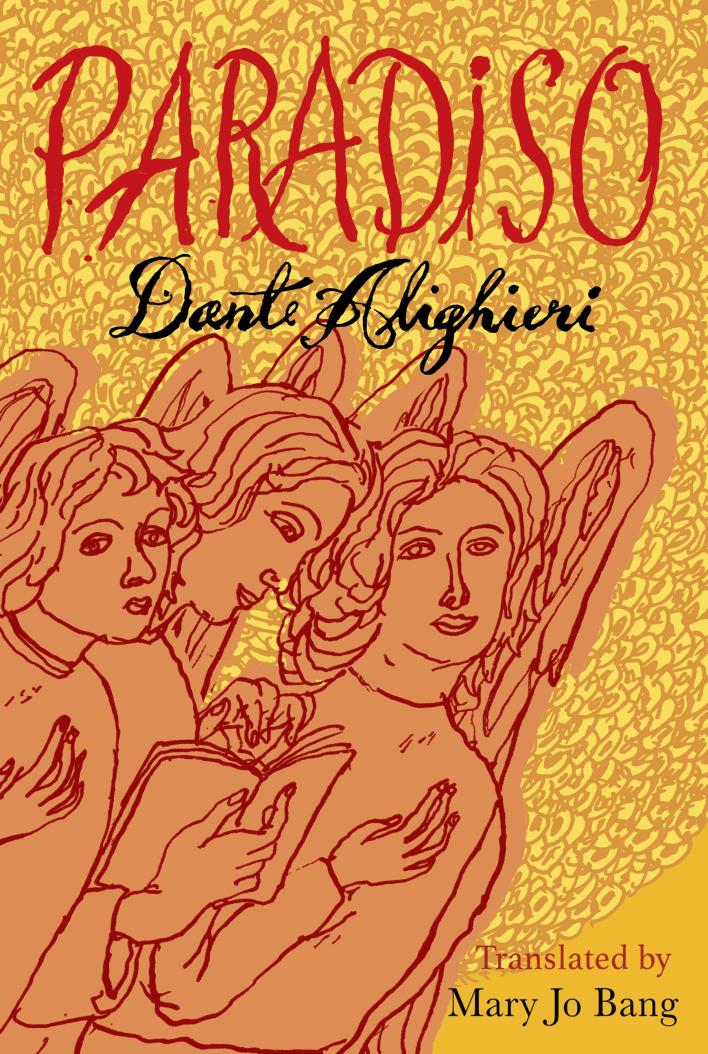
Mary Jo Bang, Paradiso: Dante Alighieri, translated by Mary Jo Bang (2025)
“Roughly half a millennium after Dante’s death, his poem received an ecstatic welcome in the United States, where Henry Wadsworth Longfellow embarked on the first American translation of all three parts in the early 1860s, as the Civil War raged.”
“Thankfully, Longfellow avoided trying to reproduce Dante’s original terza-rima scheme (in which the last word in the second line of a tercet provides the first and third rhyme of the next tercet).Instead, he chose the more forgiving blank verse, which works much better in English, a rhyme-poor language without Italian’s abundance of vowel sounds at the end of words. His translation, published in 1867, was wildly popular.”
“Since then, about 50 other American renditions of the entire poem have appeared. None is as provocative as the one that Mary Jo Bang, a poet, has been working on for the better part of two decades. And none is attuned to Longfellow’s democratic urge to spread Dante’s message of unity either. Following her Inferno (2012) and Purgatorio (2021), Bang’s Paradiso has arrived at a moment of national turmoil, and sets out to make a vision of hope and humility accessible to all in an unusual way.”
“Bang’s unconventional approach was inspired by an encounter with a medley of 47 different English translations of the Inferno‘s famous first three lines assembled by the poet Caroline Bergvall. Never having studied Italian, Bang saw a chance to try her hand by relying on those variations, along with Charles S. Singleton’s translation (already on her shelf). The 47 variations mostly struck her as formal and ‘elevated,’ and she was curious to discover how contemporary English would sound. In the process, she arrived at something fresh. ‘Stopped mid-motion in the middle / Of what we call our life,’ her tercet began, conveying an abrupt jolt, as if a roller coaster was kicking into gear, and then went on: ‘I looked up and saw no sky— / Only a dense cage of leaf, tree, and twig. I was lost.’ […]” —Eric Bulson, “What Dante Is Trying to Tell Us: A colloquial translation of Paradiso might make people actually read it,” The Atlantic, Vol. 337-No. 2, February 2026.
Sighting Citation:
“Mary Jo Bang, Paradiso: Dante Alighieri, translated by Mary Jo Bang (2025).” Dante Today: Citings and Sightings of Dante’s Works in Contemporary Culture. Elizabeth Coggeshall and Arielle Saiber, eds. June 25, 2026. https://dantetoday.org/sightings/mary-jo-bang-paradiso-dante-alighieri-translated-by-mary-jo-bang-2025/.